

Traffic data collection is the process of gathering information about traffic movements and density. It involves accumulating insights about vehicular movements. When processed in real-time, this information aids in optimizing traffic flow, identifying current congestion points, and managing urban density.
Besides that, traffic data collection plays a fundamental role in shaping the decisions of city planners, transport agencies, and governmental bodies. This data informs them about the volume, flow, and movement patterns of vehicles in particular zones. Performing elaborate investigation enables them to make well-informed decisions.
Regularly companies, that specialize in traffic counting and traffic data collection reach out to us. Often they are transitioning from manual or analog methods towards adopting Artificial Intelligence to automate their counting procedures. As a manufacturer of smart camera systems this transition underscores the possibilities of our technology in transportation and urban planning. Given this context, it’s timely to explore the various traffic data collection methods and touch on the role of ANPR (Automatic Number Plate Recognition) cameras in this domain.
In this article we will delve into the diverse methods used to collect traffic data, how this data is interpretated in tangible situations, and the emerging innovations in the realm of traffic data collection techniques. To start, let’s understand the significance of traffic data collection.
The significance of traffic data collection
Collecting traffic data is a crucial method that provides essential information for enhancing traffic control and infrastructure projects. Through this data, transportation specialists gain a deeper understanding of various factors, such as the number of vehicles, their classifications, their traveling speeds, and more.
For transportation professionals, this information is invaluable for several purposes: pinpointing transportation requirements, assessing the effectiveness of traffic systems, determining vehicular trends, and informing evidence-based choices in city development.
Seven methods to collect traffic data
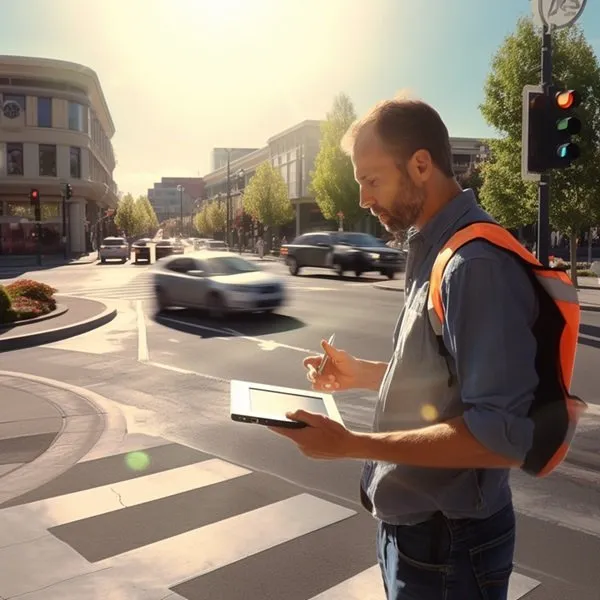
Method 1: on site tracking
This method requires an individual to be present beside the road, diligently noting each vehicle that passes. Unlike automated devices that capture vehicular movements, this process relies heavily on human intervention and observation.
Advantages
- Hassle-free initiation due to the absence of required installations.
- Economical for monitoring roads with less traffic.
- Ability to simultaneously collect data from various points for verification.
- Unaffected by network or connectivity issues, making it suitable for both urban and remote settings.
Disadvantages
- Elevated labour expenses associated with hiring and training counters.
- Safety risks for those tallying the vehicles.
- Less efficient when dealing with high-traffic areas or multi-lane roads.
- Prone to errors attributed to human oversight.
- Limited ability to classify vehicles and lacks speed data capture
Method 2: pneumatic tubes

Advantages
- Widely recognized and trusted due to its historical use.
- Economically viable for many agencies, with many already owning the required equipment.
- Simple to deploy and shift between different sites.
Disadvantages
- Not suitable for roads experiencing heavy traffic or areas with slow-moving vehicles.
- Unreliable vehicle classification performance.
- Restricted placement, particularly in zones where vehicles might park.
- Operational efficiency can be hampered in certain weather conditions, notably rain.
- Possible safety risks during the tubes’ setup and removal phases.
- Tends to wear out quickly and is susceptible to damage.

Method 3: inductive loops
Advantages
- A time-tested and widely accepted traffic monitoring method.
- Economically feasible, particularly if the loops are already in place.
- Capable of functioning efficiently regardless of lighting or weather variations.
- Advanced or double loops can measure speed and provide vehicle classification.
Disadvantages
- Installation can lead to traffic interruptions and potential safety issues.
- Vulnerable to damage from water infiltration or regular roadworks.
- Inadequate installation or maintenance compromises data accuracy.
- Limitations in detecting vehicles with lower metal content, like motorcycles.
Method 4: thermal imaging traffic detection systems

Advantages
- Unaffected by variations in light, such as darkness, sun glare, or shadows
- Eliminates the need for manual intervention post-installation
- Avoids traffic disruptions and safety concerns
- Ensures privacy as it doesn’t identify vehicles or pedestrians
Disadvantages
- Tends to be pricier than conventional methods
- Requires strategic positioning at an appropriate height and location.

Method 5: radar technology
Advantages
- Work under all weather conditions
- No manual labor or safety concerns
- Lowest power consumption
- Highest count and classification accuracy
Disadvantages
- More expensive than in-road methods
- Less effective when vehicles are stationary
- Still relatively new compared to previous methods
Method 6: artificial intelligence

Advantages
- Visual AI systems can identify and classify vehicles with a high degree of accuracy
- Visual AI can process and analyse data in real-time, enabling instant insights and rapid response to changing traffic patterns.
- It can be trained and retrained to recognize newer vehicle types or to adapt to different traffic scenarios.
- Beyond just counting vehicles, Visual AI can discern vehicle types, speeds, and even behavioural patterns like lane changing.
- Visual AI data can be easily integrated with other smart city systems or traffic management solutions for a holistic approach.
Disadvantages
- Adverse weather conditions like fog, heavy rain, or inadequate lighting can affect the clarity of images, potentially impacting data accuracy.
- Storing high-resolution video feeds can require substantial storage solutions, leading to additional costs and potential data management issues, unless when edge computing cameras are being used.
- Unlike some methods, visual AI systems can’t measure physical parameters like weight-in-motion.

Method 7: ANPR (Automated Number Plate Recognition)
ANPR or LPR is a specialized technology that employs optical character recognition to automatically read and interpret vehicle registration plates. Within the sphere of traffic data collection, ANPR plays a vital role. ANPR in traffic data collection serves a dual purpose. Beyond the mere counting of vehicles, it provides the unique ability to identify individual vehicles through their registration plates. This identification allows for in-depth analysis, such as determining the frequency of a particular vehicle’s presence at a specific location. Consequently, one can discern whether the traffic comprises new vehicles each time or represents recurrent patterns, offering insights into regularity and habits in vehicular movement.
Advantages
- Quickly reads and processes vehicle registration plates.
- The ability to not only count vehicles but also identify individual vehicles, providing insights into traffic regularity and vehicular habits at specific locations.
- When embedded, quick response times and decreased data transfer requirements
Disadvantages
- Different plate designs and layouts can occasionally pose recognition challenges.
- Adverse conditions like mud, rain, or snow can obscure plates, impacting efficiency.
Traffic Data Collection Setups: Temporary vs. Permanent
Temporary set up
In the dynamic realm of traffic monitoring and management, temporary traffic data collection offers a versatile and adaptable approach to understanding road usage patterns. Instead of committing to long-term installations, agencies and researchers can deploy these ephemeral systems to gather short-term, specific data. This method is particularly useful for projects that require flexibility, quick insights, or those conducted in ever-changing urban environments. Whether it’s for understanding the impact of a recent road change, measuring the effects of a short-term event, or just getting a snapshot of current conditions, temporary traffic data collection serves as an invaluable tool in the arsenal of traffic management professionals.
Advantages
- Can be quickly deployed and relocated as needed, catering to changing requirements or new areas of interest.
- Often cheaper in the short term, as there’s no commitment to a permanent installation or associated maintenance.
- Ideal for one-time studies, events, or seasonal variations.
- Temporary setups usually require minimal or no modifications to the existing infrastructure.
- Provides quick insights into sudden traffic changes or for immediate decision-making.
- Less long-term care is needed as the setup is for a limited period.
- Allows for trial and testing of new technologies or methods before deciding on a permanent solution.
Disadvantages
- Cannot capture extended trends or year-round variations.
- Each deployment requires setting up the equipment anew, which can consume time and resources.
- Changing locations or minor adjustments between deployments can result in inconsistent data.
- Temporary setups might not be as robust as permanent installations, making them more susceptible to damage or tampering.
- Some advanced features available in permanent setups might be unavailable in temporary ones.
- Frequent deployments over time can eventually become more expensive than a one-time permanent setup.
Permanent set up
Permanent traffic data collection stands as a cornerstone in the continuous observation and management of our roadways. These enduring systems, once established, provide consistent and long-term data, painting a clear picture of traffic trends, patterns, and behaviours over extended periods. Such setups are instrumental for urban planners, researchers, and policymakers in making informed decisions about infrastructure development, safety enhancements, and transportation policies. While they require a more significant initial investment, their continuous operation offers a wealth of data, ensuring that the pulse of our roads is constantly monitored, helping cities and regions evolve in tandem with their traffic needs.
Advantages
- Allows for a long-term analysis of traffic trends, providing richer datasets.
- Once set up, they provide consistent data collection without the need for regular adjustments.
- Can be merged with other traffic management or data collection systems for enhanced efficiency.
- With dedicated power sources and protection from external factors, they often have a longer operational life.
Disadvantages
- Setting up permanent systems generally requires a more substantial initial outlay.
- Relocating or modifying these systems can be challenging and costly.
- Over time, as technology evolves, these systems might require significant upgrades or replacements to stay current.
In a nutshell, whether opting for a temporary or permanent traffic data collection setup, the choice hinges on the project’s specific objectives, duration, and available resources.
Conclusions
In the realm of traffic data collection, there’s no one-size-fits-all solution. The optimal method largely hinges on the unique objectives and requirements of your project. While some technologies may excel in certain environments or under specific conditions, others might offer advantages that align more closely with your goals. It’s essential to recognize that there isn’t a singular “best” method; rather, there’s a “most suitable” approach tailored to your needs.
If you’re willing to explore what our camera systems can offer in this ever-evolving field, our sales department is ready to guide you. Reach out and discover the possibilities that await.


